
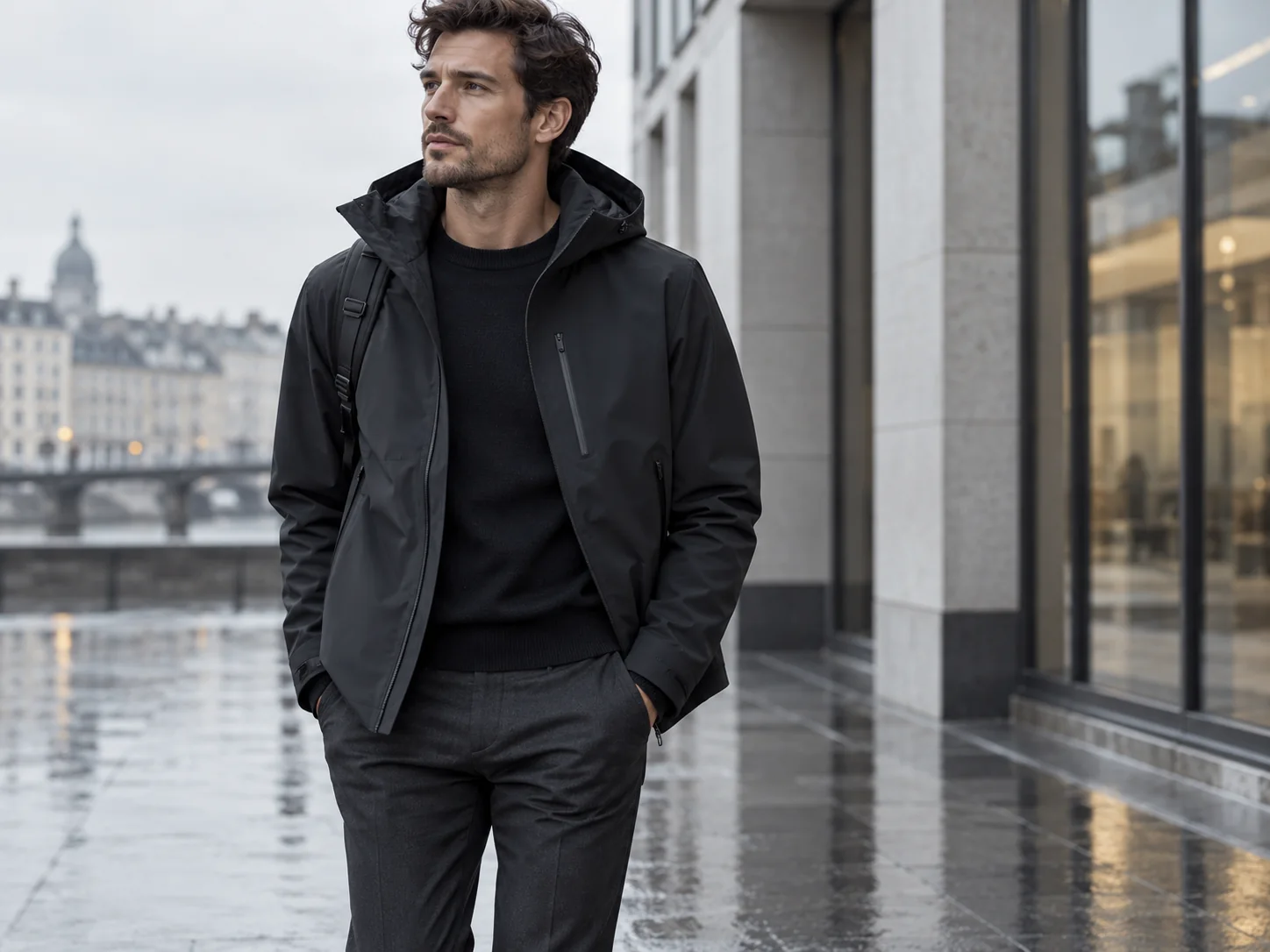
A waterproof jacket becomes TechnoCasual when the weather protection stops dictating the outfit. Traditional outdoor shells are excellent tools, but many are designed around hiking priorities: helmet-compatible hoods, large external pockets, stiff fabrics and obvious technical detailing. In a city, the problem is different. You want to stay dry, carry a phone and perhaps a backpack, then walk into an office, restaurant or hotel without immediately feeling dressed for a mountain.
That makes restraint part of the performance brief. A clean front, controlled volume, a hood that packs or sits neatly, and fabric that does not sound or shine excessively can matter almost as much as the headline waterproof specification.
Three approaches to city rain
Next DryTech Packable Jacket
TC 71· StrongWaterproof, taped seams and designed to pack down small.
View at Next Ireland →Rains Long Jacket
TC 81· StrongMinimal urban raincoat styling with welded seams.
View at Rains →Arc'teryx Veilance Field Jacket
TC 86· CoreA highly technical waterproof shell disguised as restrained city outerwear.
View at Arc'teryx →Prices and availability can change. Product pages checked 4 October 2026; “See retailer” is used where the current price may vary by selection.
| Approach | Strength | Watch for |
|---|---|---|
| Packable shell | Low cost, light weight, easy to carry | More outdoorsy styling and fabric feel |
| Minimal raincoat | Strong city integration | Less adaptable for hard activity |
| Premium technical city shell | High performance with restrained design | Very high price |
Waterproof is only the beginning
The word “waterproof” is useful, but it does not tell you how pleasant a jacket is to wear. A membrane can keep rain out while trapping heat and moisture inside. In everyday use, comfort depends on fabric feel, cut, ventilation and what you wear underneath. If a jacket is mainly for walking between train, office and restaurant, breathability may matter differently than it would during a steep hike.
Think about your real exposure. For ten-minute urban showers, a clean water-resistant coat may be enough. For Irish winter commutes, long walks or travel where you cannot retreat indoors, fully waterproof construction and protected seams become more important.
The silhouette decides whether it stays on indoors
A good city shell should look coherent over a knit, shirt or overshirt. Hip-length and thigh-length shapes are generally easier to integrate than short, highly articulated mountain shells. Muted colours help, but the bigger issue is visual noise: contrast zips, giant logos and complicated pocket geometry make the jacket read as equipment.
Rains succeeds partly because it accepts that a raincoat can look like a raincoat, then keeps the geometry minimal. Veilance takes the opposite premium route: sophisticated technical construction is present, but much of it is visually suppressed. The Next jacket is more overtly practical, but its price and packability make it useful as an emergency layer.
Hood design matters more than most product pages suggest
A hood that protects well but collapses over the eyes is frustrating. Look for useful adjustment at the crown or face, enough depth to cover the forehead, and a shape that does not create a huge bundle behind the neck when down. For everyday wear, the hood should also look acceptable when it is not raining; this is where many hiking shells feel overbuilt.
Cuffs, zips and pockets are the everyday details
Water often enters at the boring places: cuffs, zip openings and pocket edges. Adjustable cuffs are useful when cycling or carrying an umbrella, but bulky hook-and-loop tabs can make a jacket harder to dress up. A two-way front zip can improve comfort on longer coats. Pockets should remain usable with a backpack or shoulder bag and should not force valuables into exposed positions.
Packability versus structure
The more packable a jacket becomes, the more likely it is to use a thin fabric that reads as technical. That is not a flaw if you genuinely need to carry it in a small bag. But if the jacket will be worn most days, a little more structure can make it look and feel substantially better. The right answer depends on whether the garment lives on your body or in your luggage.
How the three picks differ
Next DryTech Packable Jacket — emergency practicality
Its proposition is straightforward: waterproof construction, taped seams and compact packing at a low price. It is the least refined of the three, but it can be the rational choice for somebody who needs a lightweight shell in a work bag or suitcase rather than a daily premium coat.
Rains Long Jacket — city first
The Rains Long Jacket makes its case through a minimal urban silhouette and welded-seam rainwear construction. The longer shape adds useful coverage and works naturally with everyday clothing. It is a strong example of integration because the function is obvious without becoming visually complicated.
Veilance Field Jacket — premium integration
The Field Jacket is the purest demonstration of the TechnoCasual idea in this shortlist: advanced waterproof capability packaged as restrained city outerwear. The price is the obvious objection. A high TC score does not make €900 good value; it simply says the category balance is unusually complete.
A simple buying checklist
- Will you still like the jacket when it is not raining?
- Does it fit over your normal mid-layer without looking oversized?
- Can the hood be adjusted without becoming bulky?
- Are the pockets usable with your usual bag?
- Does the fabric feel acceptable against the neck and hands?
- Are you paying for capability you will actually use?